
The new generation of ornamental fountains combines advanced sensors, DMX/PLC control, and artificial intelligence to offer immersive and measurable experiences. In this guide, we explain how AI can transform a traditional fountain into a living ecosystem that responds to its environment, interacts with people, and optimizes its energy and operational performance.
From static works of art to intelligent urban organisms
Ornamental fountains have been an expression of art, engineering, and social gathering for centuries. However, by 2025, the way the public experiences urban spaces has changed: we seek interaction, response, and surprise.
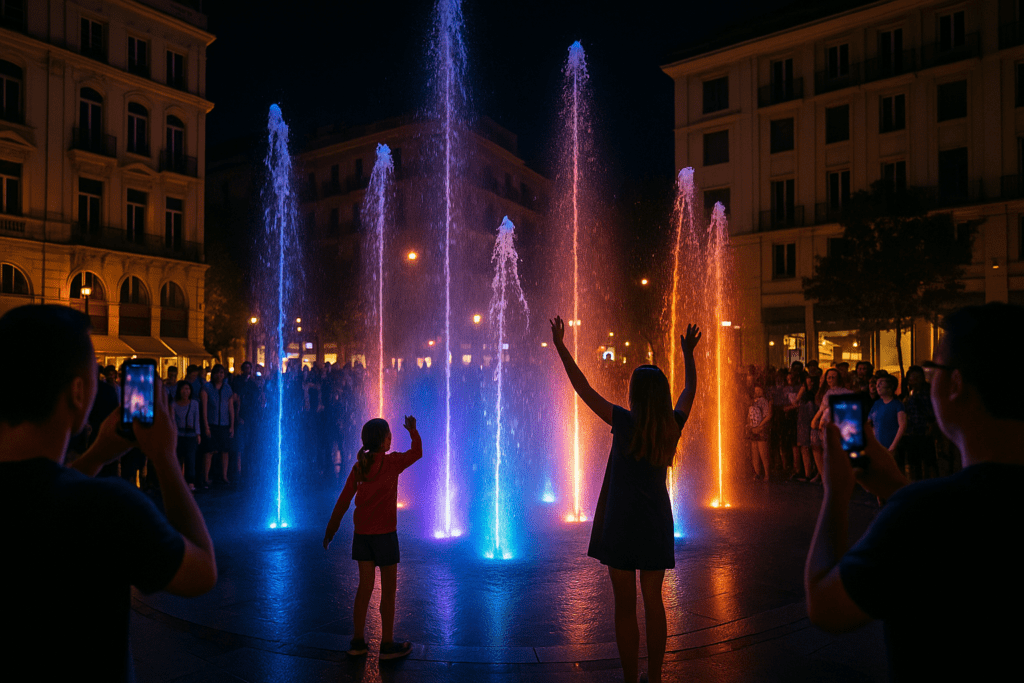
Artificial intelligence allows a fountain to cease being a passive element and become a sensitive urban organism, capable of perceiving its surroundings, understanding human behavior, and reacting in real time.
Thanks to the combination of sensors, computer vision, and digital control, water and light can now follow our movements, adapt to the weather, respond to music, or even tell personalized stories. What was once an aesthetic installation can now be an experiential medium that creates emotional connections, encourages participation, and improves sustainability.
What is an AI font (and what makes it different)?
An artificial intelligence fountain is not just a fountain with sensors. It is a facility capable of perceiving, deciding, and acting on its own, based on data and context.
Its main components are:
- Sensors: detect variables such as wind, temperature, capacity, or flow.
- Cameras and microphones: enable gesture recognition or music rhythm detection, processing information locally to protect privacy.
- AI models: interpret this data and define coherent responses, adapting the source in real time.
- PLC/DMX controllers: translate decisions into precise actions on jets, lights, or sound.
- Orchestration layer: allows you to program scenes, schedules, and automatic modes according to environmental or social conditions.
- Analytics dashboard: records metrics on consumption, traffic, and performance to optimize operations.

Experiences made possible by AI
1. Gestural interaction and interaction through presence
As you approach, the fountain “greets” you with a display of jets and lights. If someone raises their hand, the water responds; if a group dances, the patterns change to the rhythm.
All this happens thanks to a computer vision model that interprets gestures and positions and translates them into instant control commands.
The result is a playful, accessible, and secure experience, with latencies of less than 100 milliseconds. Each person feels that the source “sees” them and responds organically.
2. Individual and collective gamification
AI also allows fountains to become urban playgrounds.
We can design simple dynamics—such as synchronizing clapping with a sequence of lights or achieving certain collective movements to activate a “final show”—or more complex ones, connected to apps or QR codes in the environment.
These experiences transform a square into an active meeting place, encourage repeat visits, and generate a constant flow of content shared on social media.
3. Generative narratives and living calendars
Using language models and content generation, fonts can adopt “narrative modes” linked to dates or contexts:
a festive mode with local music and warm lighting during the holidays, an autumn mode with soft tones and slow movements, or an ecological mode with patterns inspired by nature.
AI analyzes events, weather, and foot traffic and suggests automatic variations in color, rhythm, and pressure. This way, every day the font has something new to say.
Smart operation: efficiency, maintenance, and safety
In addition to improving the experience, AI optimizes technical management:
- Energy efficiency: adjusts flow rate and light output according to the time of day, number of visitors, or wind conditions.
- Predictive maintenance: detects anomalies in pressure, flow, or sound that anticipate pump or nozzle failures.
- Security and compliance: edge cameras identify falls or intrusions and the system applies secure modes; all data processing is performed locally, in compliance with GDPR.
How to migrate from a traditional font to an AI font
- Technical audit: pumps, valves, lighting fixtures, and electrical panels are analyzed to identify what can be reused.
- Interaction and narrative design: the types of experience, game modes, and safety rules are defined.
- Architecture and security: segmented networks, encryption, and local data processing are established.
- Hardware/software integration: sensors, cameras, gateways, and the control platform are installed.
- Training and calibration: AI models are adjusted to correctly interpret the environment.
- Implementation and measurement: KPI dashboards and smart maintenance protocols are configured.
Measure to improve: the new KPIs from a living source
An intelligent fountain is not measured solely in liters or lumens.
The indicators of success are now also emotional and social:
- Dwell time: how long people spend enjoying the fountain.
- Engagement: percentage of visitors who interact.
- Energy savings: optimized consumption thanks to AI.
- Reduced incidents: less wear and tear and better continuity.
- User-generated content (UGC): number of social posts or mentions.
Privacy and ethics: Responsible and transparent AI
“GDPR by design” is a priority.
Attikkal’s AI fonts are developed under three principles:
- Data minimization: no images or personal identifiers are stored; only aggregated metrics.
- Local processing: everything happens at the edge, without dependence on the cloud.
- Transparency: signage explaining the use of AI, safe zones, and citizens’ rights is included.
Frequently asked questions
Yes. In most cases, the existing hydraulic and electrical systems are utilized, with the addition of compatible sensors and controllers.
The main logic runs on local devices. If the network goes down, the source maintains a preprogrammed safe mode.
AI adjusts power according to traffic, weather, and time of day, ensuring savings without compromising visual impact.
Yes, but for the better: the system detects wear and leaks before they become a problem, allowing for planned interventions.
No. The models run on dedicated hardware with a response time of less than a tenth of a second.
Checklist: Technical evaluation for an AI font
Infrastructure
- Updated hydraulic and electrical diagram
- List of pumps, valves, and lighting fixtures
- Electrical panel with space for gateways and UPS
Connectivity and security
- Segmented network for orchestrator and PLC
- Edge device with acceleration (GPU or NPU)
- Patch and backup policies
Experience
- Defined use cases (interaction, play, narrative)
- Scenes according to weather conditions
- Noise and light limits by time of day
Legal and operations
- GDPR signage and retention plan
- Content approval protocol
- Defined KPIs and scorecard
A more vibrant, sustainable, and humane future
Ornamental fountains with artificial intelligence are not a technological fad: they are the next logical step in the evolution of public spaces.
By integrating AI, we transform a static element into a changing, inclusive, and efficient experience that provides both aesthetic and economic value.
At Attikkal, we are developing projects that already apply this vision: fonts that learn, play, and excite.
Request a demo or feasibility assessment
Whether you manage an existing source or are designing a new space, we can help you assess the potential of AI to improve its impact and sustainability.
Request a personalized demo or feasibility assessment, and we will show you how to apply this technology step by step, with estimated costs, timelines, and return on investment.